
Telstra Overruled in Mobile Coverage Claims Dispute
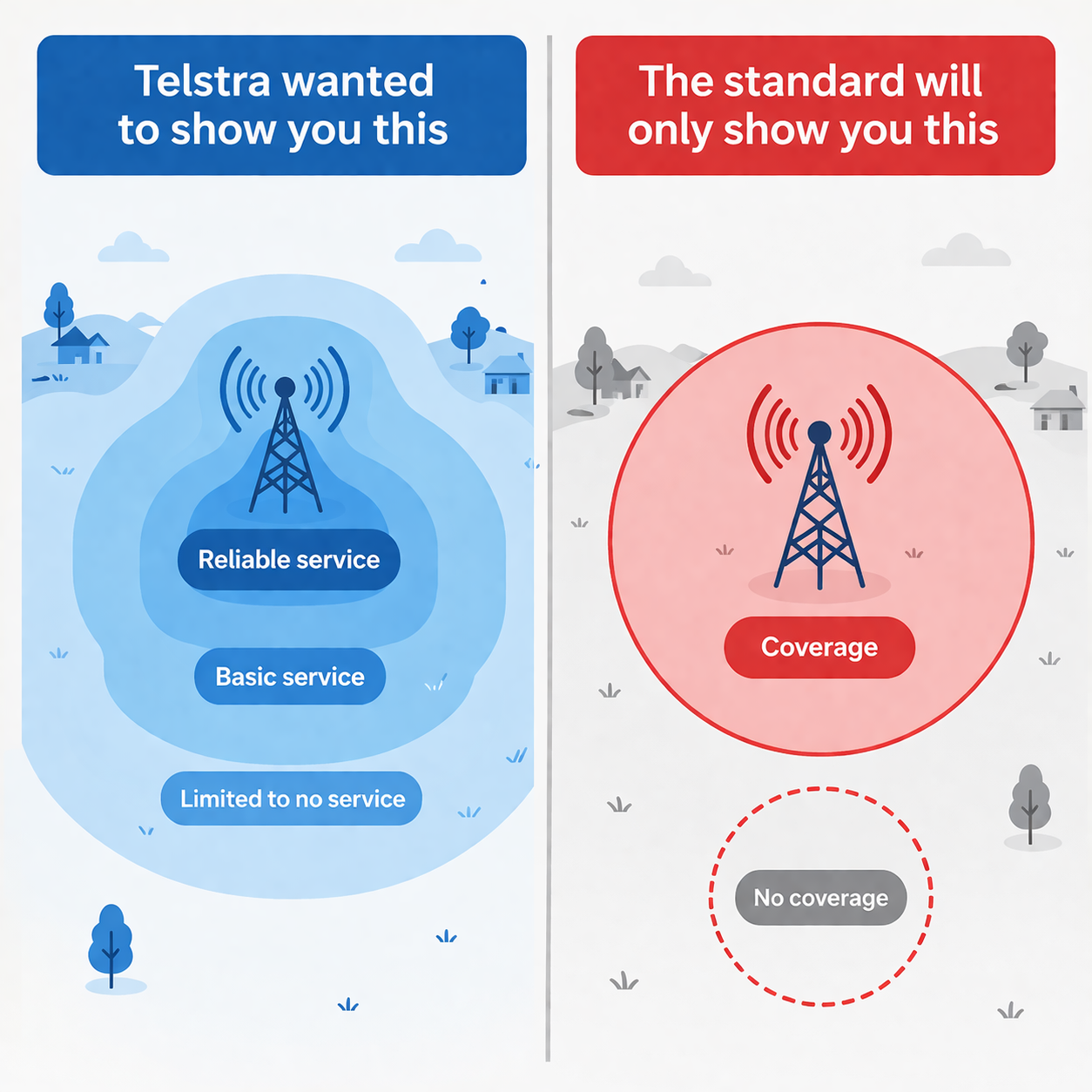
Telstra has pushed back against a new mobile coverage mapping standard introduced by the Australian Communications and Media Authority (ACMA), arguing that the new rules could confuse customers and fail to reflect real-world mobile performance. However, the regulator has decided to proceed with the new standard despite Telstra’s objections.
Under the new ACMA rules, mobile carriers in Australia will be required to classify coverage areas based on signal strength using four categories: good coverage, moderate coverage, useable coverage, and no coverage. According to the new standard, areas with signal strength lower than -115 dBm will be classified as having no coverage. Areas with signal strength stronger than -95 dBm will be considered to have good coverage, while moderate coverage will fall between -105 dBm and -115 dBm.
This new threshold could have a major impact on Telstra’s coverage maps. The company may be required to remove up to one million square kilometres of area that is currently marked as having mobile service on its coverage map.
Telstra’s competitors, TPG Telecom and Optus, support the new coverage definition. Optus stated that signal levels below -115 dBm are not reliable enough to be considered usable service. TPG Telecom also conducted its own testing on Telstra’s network in areas claimed to have full coverage and found that while a phone might show a signal, it would often not be able to successfully make a call using a standard smartphone.
TPG Telecom criticized Telstra’s coverage claims, stating that coverage should mean a phone actually works, not just that it occasionally shows a signal bar.
Telstra, however, defended its position by presenting its own network data. The company said that around 1.5 million customers per month connect to its network in low signal areas, and about 57,000 emergency triple zero calls are made each year from these areas. Telstra emphasized that its network coverage has not changed and that no towers have been shut down.
Telstra also shared results from its own testing conducted in late 2025, claiming that even at signal strength levels as low as -122 dBm, standard smartphones were able to load websites within seconds, open apps without significant delay, and make clear voice calls.
Telstra said it supports the idea of a single national standard for coverage maps so customers can compare providers easily, but it believes the new standard may label areas with real-world usage as having “no coverage,” which could mislead customers.
ACMA Chair Nerida O’Loughlin defended the new rules, stating that the new standard will ensure all carriers provide consistent and comparable coverage information so consumers can accurately understand whether their phone will work in a specific area, especially in regional and rural Australia.
Both Optus and TPG Telecom welcomed the new standard, saying it will help customers make better decisions and prevent overstated coverage claims. They also said the new rules reflect real-world user experience rather than theoretical network predictions.
Under the new regulations, mobile carriers will be required to update their coverage maps every three months to ensure the information remains accurate and up to date.
This dispute highlights the ongoing challenge in the telecommunications industry: balancing technical signal measurements with real-world user experience, especially in large rural and regional areas where coverage can vary significantly.





- « Previous
- 1
- …
- 15
- 16
- 17